
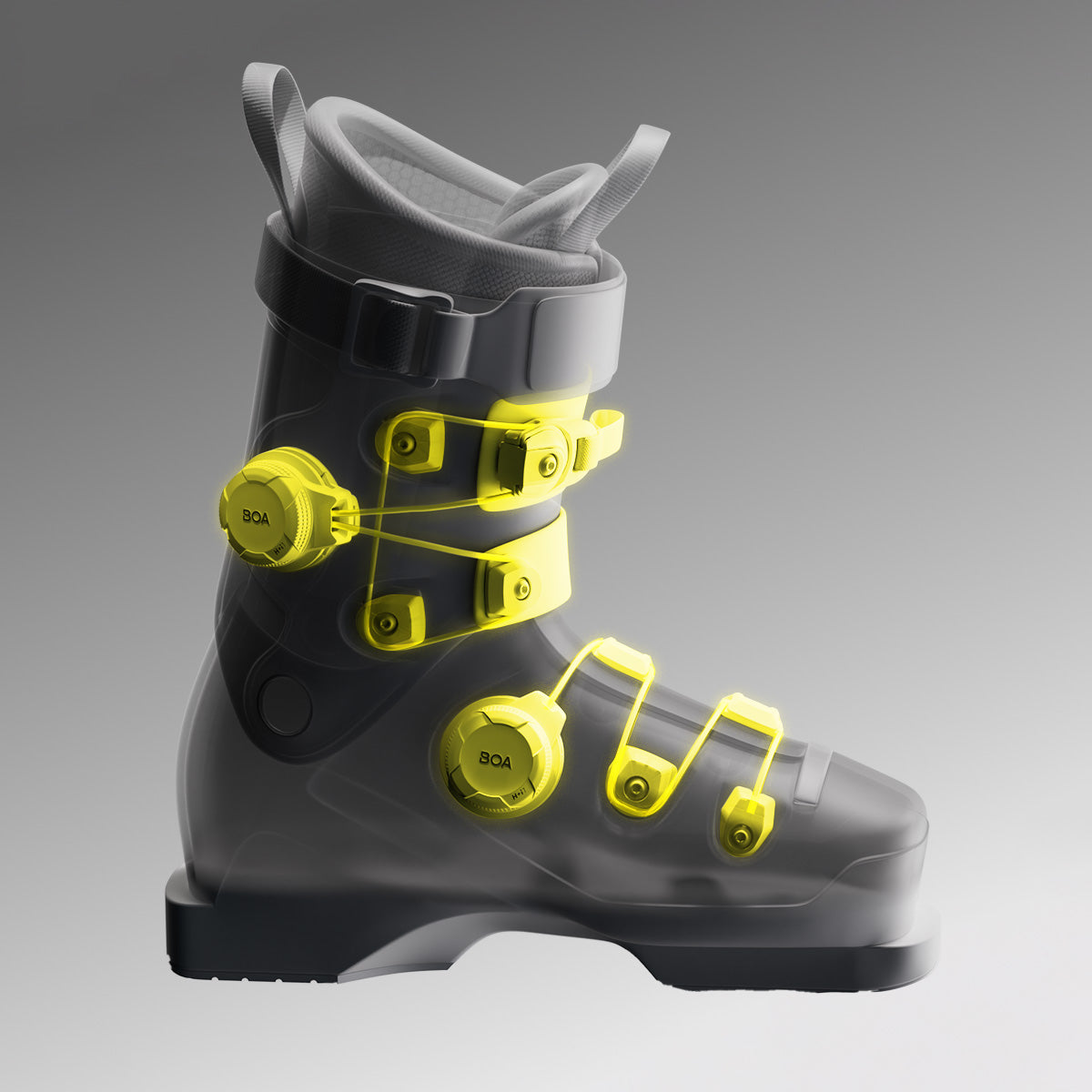
A Real-World Look at BOA Coilers vs Buckles from The Pro Ski and Ride
Over the past few seasons, BOA ski boots have become one of the most talked-about developments in alpine equipment. What started as a niche closure system has quickly expanded across multiple brands and boot categories — from comfort-focused recreational boots to high-performance models.
But with all the attention, many skiers are asking the same question:
Are BOA ski boots actually better, or is it just hype?
At The Pro Ski and Ride, we've been fitting ski boots with BOA since their launch in the 2022–2023 season. We fit approximately 500 ski boots per year, and roughly one-third now include at least one BOA coiler. With over 80 models of ski boots stocked each season, we've had the opportunity to evaluate BOA across a wide range of foot shapes, skier types, and performance levels.
The short answer: BOA is a strong closure system — but it’s not automatically better than buckles. Like anything in ski boot fitting, the right choice depends on the skier and, most importantly, proper fit.
If you're currently comparing options, you can browse all available models here:
https://theproskiandride.com/collections/ski-boots
What Is a BOA Ski Boot?
A BOA ski boot replaces one or more pairs of traditional buckles with a dial-based closure system that tightens a cable across the shell. This cable distributes pressure more evenly across the foot or leg depending on placement.
There are now several configurations available:
- Dual BOA systems on the lower shell and upper cuff
- BOA lower shell with buckle upper cuff
- Buckle lower shell with BOA upper cuff
- Traditional all-buckle boots
This variety is one reason BOA has expanded so quickly — it can be implemented in different ways depending on the boot design, skier preference, and intended use.
The Most Important Thing: BOA Does Not Replace Proper Boot Fit
Before discussing performance or durability, it's important to address the biggest misconception about BOA ski boots:
BOA is a closure system — not a silver bullet.
A BOA dial cannot fix:
- Wrong size
- Wrong last width
- Incorrect instep height
- Improper shell shape
- Poor heel hold
A BOA boot still needs to fit correctly just like a buckle boot. If a ski boot does not match your foot shape, switching to BOA will not solve the problem.
This is why professional fitting still matters regardless of closure system. If you're unsure where to start, learn more about the fitting process at The Pro Ski and Ride here:
https://theproskiandride.com/pages/boot-fitting-process
BOA vs Buckles: The Biggest Differences
Pressure Distribution
BOA provides a more even wrap across the foot and/or legshaft. Instead of pressure coming from specific buckle points, the cable distributes tension more uniformly.
Buckles create more direct pressure in specific areas. This can be beneficial for skiers looking to collapse the ceiling of the boot or increase engagement over the instep or toes.
Neither is inherently better — they simply feel different.
Adjustability
BOA offers nearly infinite micro-adjustments. Small turns of the dial allow very fine tuning of pressure.
Buckles provide larger adjustment increments, but more total adjustment points. Because the lower and upper of the ski boot each has buckles in two positions, buckles allow more discrete pressure zones.
In practice:
- BOA = fine tuning
- Buckles = more pressure zones
Performance
One of the most common concerns is whether BOA affects performance.
We have not seen any noticeable performance drop-off compared to buckles.
Many high-performance boots now include BOA, and the closure system has not shown limitations for most skiers.
That said, racers still overwhelmingly prefer buckles. This is largely because World Cup race boots continue to use buckles. While BOA is being tested, it has not yet become standard in race environments.
BOA Placement Matters: Lower vs Upper BOA
Where BOA is located on the boot changes how it feels.
Lower BOA (Forefoot)
At The Pro Ski and Ride, we've seen lower BOA work best for:
- High instep skiers
- Skiers seeking even forefoot pressure
- Those sensitive to buckle pressure points
- Skiers wanting easier micro-adjustment
The wrap across the forefoot can create a more uniform feel compared to buckles.
Upper BOA (Cuff)
Upper BOA systems are newer but have been well received.
Skiers often notice:
- Even pressure across the legshaft
- Wrap feeling from the sides of the cuff
- Reduced shin pressure hotspots
This can create a more consistent feel through the cuff.
When Buckles May Work Better
Buckles still offer advantages in some cases.
Buckles can:
- Collapse the ceiling of the boot more effectively
- Provide targeted instep pressure
- Allow multiple pressure zones
- Offer familiar feel for racers
For some skiers, this direct pressure is preferred.
Reliability and Durability
A major concern with BOA systems is durability.
After nearly four seasons of fitting BOA ski boots:
We have not seen any BOA-specific reliability issues.
In fact, we've seen fewer BOA failures than buckle failures.
Both systems can break. Buckles can snap. BOA cables or coilers can fail. Neither is immune.
The key difference is serviceability.
BOA components:
- Are standardized
- Are screwed on
- Are easily replaceable
- Available in spare kits
- Serviceable by most ski shops
Many buckles, on the other hand, are riveted and are unique to the boot making them more difficult to replace.
What Happens If BOA Fails on the Mountain?
This is one of the most common questions.
If the BOA coiler disengages:
- It is attached via a tension clip
- The clip can be reattached
- This can often be done on the hill
Additionally:
- BOA parts are standardized
- Most shops that sell BOA boots stock repair kits
- BOA is warrantied for the life of the ski boot
In practice, failures are rare and typically easy to address.
Cold Weather Performance
Another concern is whether BOA works in cold temperatures.
We have not seen any cold-weather issues with:
- BOA
- Buckles
- Cables
- Dials
Both systems perform reliably in cold conditions.
Ease of Use
BOA offers several convenience benefits:
- Easier to tighten with gloves
- Fast adjustments on lift
- Micro adjustments during the day
- Even tightening
However, some skiers have noted:
BOA boots can be more difficult to put on than buckle counterparts.
This varies by model and foot shape.
Real Shop Experience with BOA Ski Boots
At The Pro Ski and Ride:
- BOA boots sold since 2022–2023 season
- ~500 boots fit per year
- ~1/3 include BOA
- 80+ models stocked each season
- No returns due to BOA issues
Our experience has been overwhelmingly positive, but neutral in comparison to buckles. Both systems work well when the boot fits correctly.
Fit still matters more than closure system.
If you prefer buckles, don't buy BOA just because it's new.
If you prefer BOA, don't force it into a boot that doesn't fit.
Who BOA Ski Boots Are Best For
BOA tends to work well for:
- High instep feet
- Skiers wanting even pressure
- Those sensitive to buckle hotspots
- Skiers who frequently adjust boots
- Comfort-focused skiers
- Recreational to advanced skiers
Who May Prefer Buckles
Buckles may still be better for:
- Racers
- Skiers wanting targeted pressure
- Those used to traditional feel
- Skiers wanting multiple pressure zones
- Very precise instep collapse
Brands Using BOA Ski Boots
BOA is no longer limited to a few models. Major manufacturers now use it:
- Fischer
- Salomon
- Atomic
- K2
- Tecnica
- Dalbello
- Nordica
- Lange
- Head
This broad adoption is a strong indicator that BOA is here to stay.
Example: High-Performance BOA Ski Boot
The owner of The Pro Ski and Ride personally skis in the Fischer RC4 Carbon Pro MV BOA, a high-performance model that uses BOA on the lower shell for even pressure and precise control.
https://theproskiandride.com/products/fischer-rc4-carbon-pro-mv-boa-ski-boots-2026
This is a good example of BOA being used in a performance-oriented boot, not just comfort-focused models.
The Future of BOA Ski Boots
BOA will continue expanding.
Next season we expect:
- All buckle boots
- Lower BOA boots
- Upper BOA boots
- Dual BOA boots
There will be closure options for every skier preference.
Are BOA Ski Boots Worth It?
BOA ski boots are not automatically better — but they are absolutely worth considering.
They offer:
- Even pressure
- Micro-adjustability
- Easy serviceability
- Strong reliability
- Performance equal to buckles
Buckles still offer:
- Direct pressure
- More adjustment zones
- Race familiarity
- Traditional feel
The right choice depends on fit and personal preference.
If you're currently evaluating options, browse all available ski boots here:
https://theproskiandride.com/collections/ski-boots
FAQ: BOA Ski Boots
Are BOA ski boots better than buckles?
Not necessarily. BOA provides even pressure and micro-adjustment, while buckles offer targeted pressure and multiple adjustment zones. Both perform equally well when properly fit.
Are BOA ski boots durable?
Yes. BOA systems are durable and have shown strong reliability. Components are also easily replaceable.
What happens if BOA breaks?
BOA parts are standardized and replaceable. Most ski shops that sell BOA boots carry repair kits.
Do BOA ski boots perform as well as buckles?
Yes. We have not seen any noticeable performance difference for most skiers.
Are BOA ski boots used by racers?
Not yet in World Cup race boots, but they are being tested. Most racers still prefer buckles.
Are BOA ski boots harder to put on?
Some skiers find BOA boots slightly harder to put on depending on model and fit.
Is BOA easier to use with gloves?
Yes. BOA dials are typically easier to operate with gloves than buckles.
Will BOA replace buckles?
No. Both closure systems will continue to exist. Future boots will offer multiple options.
Final Thoughts
BOA ski boots are not just hype — but they also aren’t automatically better. They are simply another closure system that works well when paired with the right fit.
The best ski boot is still the one that matches your foot shape, skiing style, and preference.
Explore all ski boot options here:
https://theproskiandride.com/collections/ski-boots