
Buying ski boots can be intimidating if you have never had a professional boot fitting before.
You may wonder how tight ski boots should feel, whether custom footbeds are necessary, or whether buying online is just as good as visiting a shop. A professional boot fitting helps answer those questions by matching your foot shape, skiing ability, and goals with the right boot.
At The Pro Ski and Ride in Hunter, NY, our boot fitting process is designed to help skiers find boots that fit properly, ski well, and can be adjusted when needed. We are located near Hunter Mountain and work with skiers from the Catskills, Hudson Valley, Albany area, NYC region, and beyond.
Here is what to expect before, during, and after a professional ski boot fitting.
Before You Leave for the Shop
A successful ski boot fitting starts before you arrive.
Bring:
-
Thin ski socks
-
Your current ski boots, if you have them
-
Any current insoles or custom footbeds
-
Your skis, your bindings will need to be checked and adjusted
-
Information about past fit issues, pain points, or injuries
-
A general idea of your skiing ability, terrain, and goals
Thin ski socks are important. Thick socks can create pressure points, take up unnecessary space, and make it harder to evaluate the true fit of the boot.
If you already own ski boots, bring them. The shell size, liner condition, buckle position, wear patterns, and previous modifications can tell a boot fitter a lot about what has or has not worked for you.
The Conversation
A boot fitting usually begins with a conversation.
Your fitter may ask where you ski, how often you ski, what terrain you prefer, your ability level, and what problems you have had with past boots.
This matters because the right boot is not the same for every skier. A beginner skiing groomers may need something different from an aggressive skier, junior racer, instructor, patroller, or someone skiing long days in challenging conditions.
The goal is not just to find your size. The goal is to find a boot that fits your foot and supports the way you ski.
Foot Assessment and Measurement

Next, the fitter evaluates your feet.
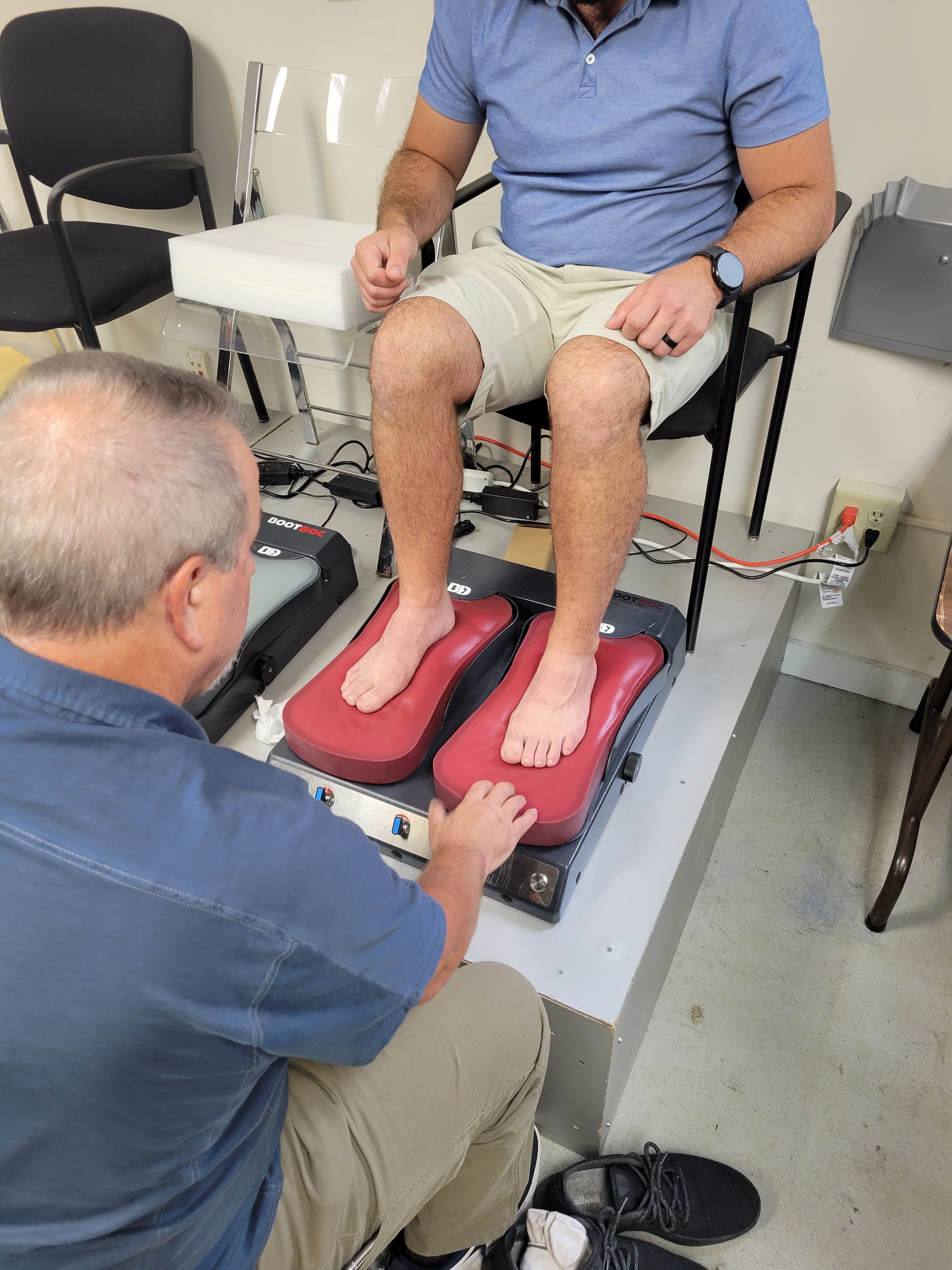
This may be done by hand, with measuring tools such as a Brannock device, or with technology such as a 3D scanner. At The Pro Ski and Ride, we use a BootDoc Vandra 3D scanner along with hands-on assessment to evaluate foot length, width, instep height, arch type, ankle shape, calf shape, range of motion, arch flexibility, and areas of concern.
Ski boot fit is affected by more than length. A fitter may look at:
-
Foot length
-
Forefoot width
-
Heel width
-
Instep height
-
Arch shape and flexibility
-
Ankle shape
-
Calf shape
-
Range of motion
-
Overall foot volume
This is one of the biggest differences between professional boot fitting and guessing from shoe size. Two skiers may wear the same street shoe size but need very different ski boots.
Boot Selection

After assessing your feet, the fitter will usually select a small number of boots that are likely to work.
A good boot fitting does not mean trying on dozens of pairs. In fact, trying too many boots can make the process more confusing. After a while, every boot starts to feel tight, loose, painful, or similar.
Most skiers are better served by trying on two or three well-chosen options. The goal is not to test every boot in the store. The goal is to start with boots that match your foot shape, ability level, and intended use.
First Fit: How the Boot Should Feel
A new ski boot should not feel like a slipper.
That does not mean it should be painful, but it should feel snug and secure. Your foot should feel held in place, especially around the heel, ankle, and midfoot.
Many skiers are surprised that the correct boot may feel tighter than expected at first. Ski boot liners break in. Foam compresses. Materials settle. A boot that feels roomy out of the box can become too loose after several days of skiing.
A professional boot fitter helps separate normal snugness from a true fit problem.
Sharp pain, numbness, burning, or strong pressure should be addressed. But snugness by itself is not always bad. Tighter is not automatically better, either. It depends where the boot is tight, how tight it is, and whether that pressure can be adjusted.
Shell Fit and Volume Check
In many fittings, the fitter may check the shell fit.
This usually involves removing the liner and placing your foot directly inside the plastic shell. The fitter can then evaluate how much space exists behind the heel and around the foot.
Shell fit helps confirm whether the boot length and shape are appropriate.
Volume is just as important as length. A boot may be the correct length but still too roomy around the ankle, instep, heel, or forefoot. Another boot may be the right length but too low-volume for your foot shape.
This is why professional boot fitting is not simply about choosing a number from a size chart.
Custom Footbeds and Support
Custom footbeds are often discussed during a boot fitting, and they are not only for expert skiers or people with unusual feet.
A supportive footbed can help stabilize the foot, reduce unwanted movement, improve alignment, and create a more consistent platform inside the boot. For many skiers, that can improve both comfort and control.
At The Pro Ski and Ride, we offer supportive insoles and custom footbeds as part of our broader boot fitting services. You can learn more on our Custom Footbeds page.
A custom footbed will not make the wrong boot right, but it can be an important part of building a better fit.
Boot Fitting Adjustments

Once the best boot is selected, the fitter may recommend adjustments.
These may include:
-
Heat molding the liner
-
Heat molding the shell
-
Shell punching
-
Shell grinding
-
Adding heel lifts
-
Adjusting cuff alignment
-
Modifying the liner
-
Adding supportive footbeds
Not every skier needs major modifications. Some boots fit well with minimal work. Others require more time and adjustment.
The important point is that the skier clearly communicates exactly what they are feeling in the boot, so the boot fitter can create an adjustment plan to address those concerns and improve the overall fit.
Binding Compatibility and Adjustment

If you purchase new ski boots, your ski bindings will need to be evaluated and possibly adjusted.
Different boots can have different sole lengths, and many modern recreational boots use GripWalk soles. Bindings must be compatible with the boot sole and adjusted properly before skiing.
This is why bringing your skis can be helpful when buying new boots. A shop technician can evaluate whether your bindings are compatible, adjust them when appropriate, and perform required testing.
If your bindings are older, worn, or non-indemnified, the shop may not be able to adjust or service them. In that case, the fitter or technician can explain your options.
Checkout and What Happens Next
By checkout, you should understand which boot was selected and why.
You should also know:
-
How the boot should feel the first day
-
What to expect during break-in
-
Whether additional adjustments may be needed after skiing
-
How to follow up if something does not feel right
A boot fitting does not always end the moment you leave the shop. Ski boots will change after the first few days on snow, and feedback from actual skiing is useful.
For boots purchased in-store at The Pro Ski and Ride, our Perfect Fit Guarantee helps support reasonable fit adjustments related to the original boot purchase.
Is In-Person Boot Fitting More Expensive Than Buying Online?
Not always.
Many skiers assume online ski boots are automatically cheaper. For current-season models, most reputable shops and online retailers sell at the manufacturer’s advertised price. That means the boot itself may cost the same whether you buy online or in person.
The difference is what comes with the purchase.
An in-person fitting gives you professional measurement, guided boot selection, fit evaluation, adjustment recommendations, and a better chance of starting with the right boot.
Ordering online can work for experienced skiers who know exactly what they need. For many people, though, the cost of returns, remounts, discomfort, lost ski days, or later boot work can outweigh the perceived savings.
Final Thoughts
A professional ski boot fitting is not about making the boot as tight as possible or trying on every model in the shop.
It is about selecting the right starting point, understanding your foot shape, matching the boot to your skiing, and making adjustments where needed.
For first-time boot buyers, skiers replacing old boots, or anyone deciding between online shopping and in-person fitting, a professional boot fitting can save time, reduce frustration, and improve comfort and control on snow. If you are an experienced skier, you likely already understand the benefits of working with a professional boot fitter.
If you are visiting Hunter Mountain or traveling from the NYC area, Hudson Valley, Albany area, or surrounding regions, The Pro Ski and Ride in Hunter, NY offers professional ski boot fitting services with trained fitters, modern assessment tools, and a practical process designed to help skiers find boots that work.