
A new ski boot can be exciting because of a clever feature. It earns a place on our fitting wall when that feature solves a real problem for a skier.
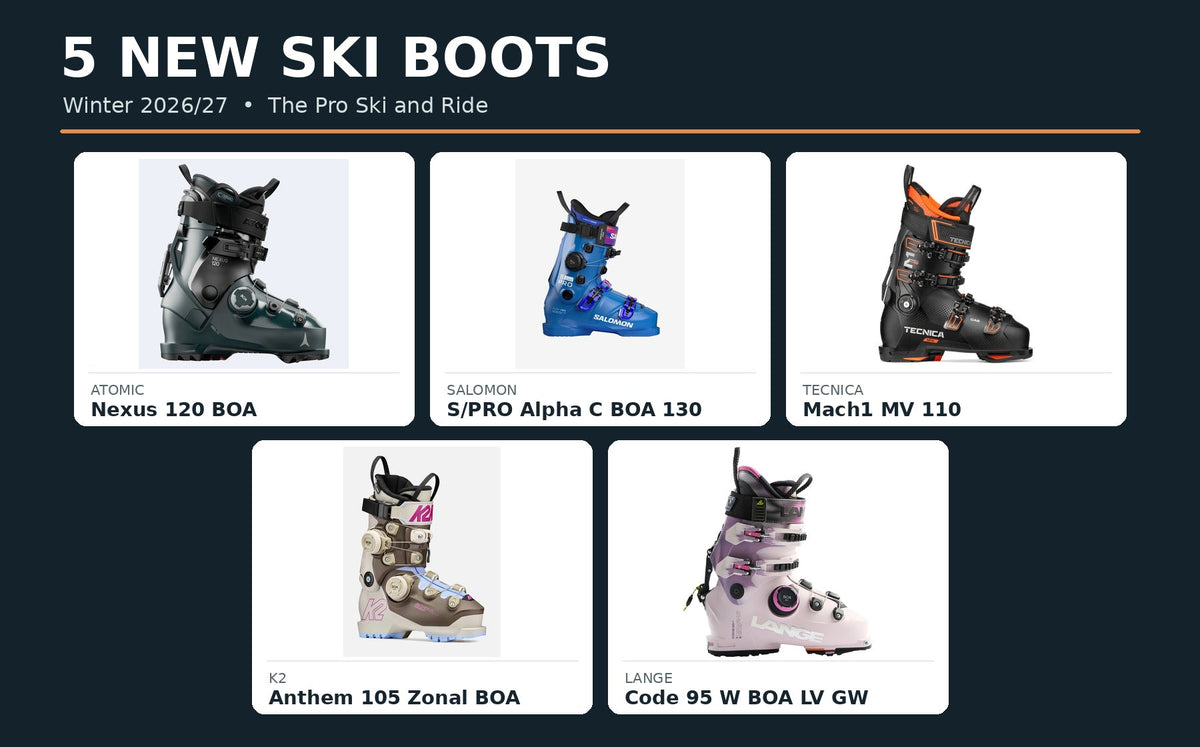
For winter 2026/27, we’re especially interested in five new boots. They cover very different needs, from easier entry to precise edge control to uphill versatility. These are listed in no particular order: the right choice depends on your foot, lower leg, skiing style, and binding setup. When in doubt, visit a qualified boot fitter.
Atomic Nexus 120 BOA: Easy entry with a performance fit

Easy-entry boots have often asked skiers to give up some of the feel they expect from a performance boot. The Atomic Nexus 120 BOA is interesting because it brings those two priorities together.
Its QuickFlip Lever opens the cuff for easier entry and exit. Once the boot is on, an adjustable upper closure secures the lower leg, while BOA wraps the lower shell around the foot. The heat-moldable Mimic liner gives us another way to refine the fit.
With a 120 flex and a roomier shape, this is one we’re eager to show strong skiers who have struggled to get into traditional boots or who need more space without automatically stepping down to a softer boot. The easy-entry design gets your attention; how it feels when you flex it is what makes it worth trying.
Salomon S/PRO Alpha C BOA 130: A distinctive feel on edge

The Salomon S/PRO Alpha C BOA 130 takes a different approach to closure: BOA adjusts the cuff, while two buckles close the lower shell. That combination gives skiers an even wrap around the lower leg and more direct buckle adjustment over the foot.
What stood out most during our testing was the boot’s Powerlink construction. To us, the flex and edge engagement felt more biased toward the inside edge than in a conventional boot. That sensation won’t appeal to every skier, but someone who enjoys driving a ski onto edge may find it compelling.
This is a narrow, stiff, race-inspired boot, and it comes with alpine soles installed. We’d want to assess the fit and stance carefully before recommending it. Skiers interested in the design who don’t want a 130 flex can also look at softer versions in the range.
Tecnica Mach1 MV 110: A meaningful update to a familiar boot

The Tecnica Mach1 MV 110 is more than a new graphic on a familiar shell. The redesigned mid-volume Mach1 brings the updated T-Drive 2.0 system and an anatomical C.A.S. shell and liner to skiers who want a precise fit without moving into a low-volume boot.
T-Drive 2.0 connects the cuff and shell to support a consistent, progressive flex. The C.A.S. construction matters just as much in the fitting room: it provides an anatomical starting shape while leaving us options to customize pressure points.
The 110 flex could be an especially good starting point for a lighter skier or someone who wants a responsive performance boot without the resistance of a 130. Skiers who like this shape but need more support can consider the 120 and 130 flex versions.
K2 Anthem 105 Zonal BOA: A women’s-specific redesign from the ground up

The K2 Anthem 105 Zonal BOA keeps a familiar name but brings a substantially new approach to the fit. K2 developed its TrueForm shape around women’s foot anatomy, with particular attention to heel hold and the shape through the foot. Its TrueAlign geometry also considers how the boot positions the skier over the ski.
Separate BOA adjustments for the cuff and lower shell let us tune the wrap in each area. An adjustable calf adds another useful fitting option, especially for skiers who find that a boot fits their foot but crowds their lower leg.
We’re excited to put this boot on skiers who want a secure heel, room where their forefoot needs it, and a balanced stance in a mid-volume boot. The 105 flex suits a capable all-mountain skier, while softer Anthem models give us other options within the redesigned range.
Lange Code 95 W BOA LV GW: Downhill focus with a walk mode

The Lange Code 95 W BOA LV GW is for a skier who wants a precise downhill feel and the ability to travel uphill. Its low-volume shape offers the close heel fit many skiers associate with Lange, with a forefoot that feels a little more accommodating than Lange’s low-volume race boots.
A lower-shell BOA closure helps secure the foot. For uphill travel, the Code adds a ski/walk mechanism, cuff mobility, and tech inserts. It also comes with GripWalk soles, so binding compatibility should be checked for the skier’s specific setup.
We see this as an intriguing option for someone who skis lifts regularly but also wants a boot capable of occasional touring. As with any hybrid boot, we’d start with the fit and the skier’s downhill priorities, then make sure the complete equipment setup works together.
Which new ski boot should you try?
A last width or flex number can help narrow the field, but it cannot tell you how a boot will hold your heel, accommodate your instep, or position your lower leg. That is why the most useful next step is to try the promising models on with a boot fitter.
The Pro Ski and Ride is near Hunter Mountain in Hunter, New York. If one of these 2027 boots caught your eye, book a boot fitting appointment. We’ll help you compare the fit and feel, then work toward the boot that makes sense for your skiing.